

Abstract
The growing literature linking negative social ties with inflammation, accelerated biological aging, and multimorbidity reflects an important change in how medicine conceptualizes disease. Emerging evidence suggests that chronic psychosocial adversity may influence inflammatory regulation, neuroendocrine function, and long-term physiological resilience through repeated activation of stress-response systems. However, psychosocial strain rarely exists independently of broader structural realities, including caregiving burden, economic insecurity, workplace instability, loneliness, and social fragmentation.
This opinion article examines psychosocial adversity as a potentially biologically consequential exposure while emphasizing the need for methodological caution in interpreting associations between emotional environments and health outcomes. Human relationships remain culturally mediated, context dependent, and difficult to quantify with precision. The challenge for modern medicine is not to medicalize ordinary emotional suffering, but to recognize that psychosocial experiences may become biologically embedded across the lifespan in ways increasingly relevant to clinical medicine, psychiatry, and public health.
Introduction
The growing body of literature linking negative social ties to inflammation, accelerated biological aging, and multimorbidity reflects a broader shift in how medicine conceptualizes disease itself. The recent study by Lee et al., examining negative social ties as risk factors for accelerated aging, challenges the longstanding separation between emotional life and biological consequences [1]. Yet the implications of this work extend beyond interpersonal conflict alone. Chronic psychosocial strain rarely exists as an isolated psychological phenomenon; rather, it is embedded within broader structural realities, including economic precarity, caregiving exhaustion, workplace instability, loneliness, digital hyperconnectivity, and social fragmentation.
This opinion article argues that
psychosocial adversity should increasingly be understood not merely as emotional discomfort, but as a potentially biologically consequential exposure capable of influencing inflammatory regulation, neuroendocrine function, and long-term physiological resilience.
At the same time, enthusiasm surrounding this field must remain balanced with methodological caution. Human relationships are dynamic, culturally mediated, and deeply contextual. Biological aging itself remains probabilistic rather than deterministic. Simplistic narratives risk flattening complex epidemiological findings into emotionally compelling but scientifically incomplete conclusions.
Modern medicine has become highly sophisticated at measuring molecular abnormalities while remaining comparatively underdeveloped in systematically recognizing chronic emotional burden.
Psychosocial stressors such as chronic loneliness, caregiving burden, emotional strain, workplace hostility, social isolation, and financial precarity may plausibly contribute to stress physiology, allostatic load, and long-term health outcomes,
as illustrated in Figure 1.
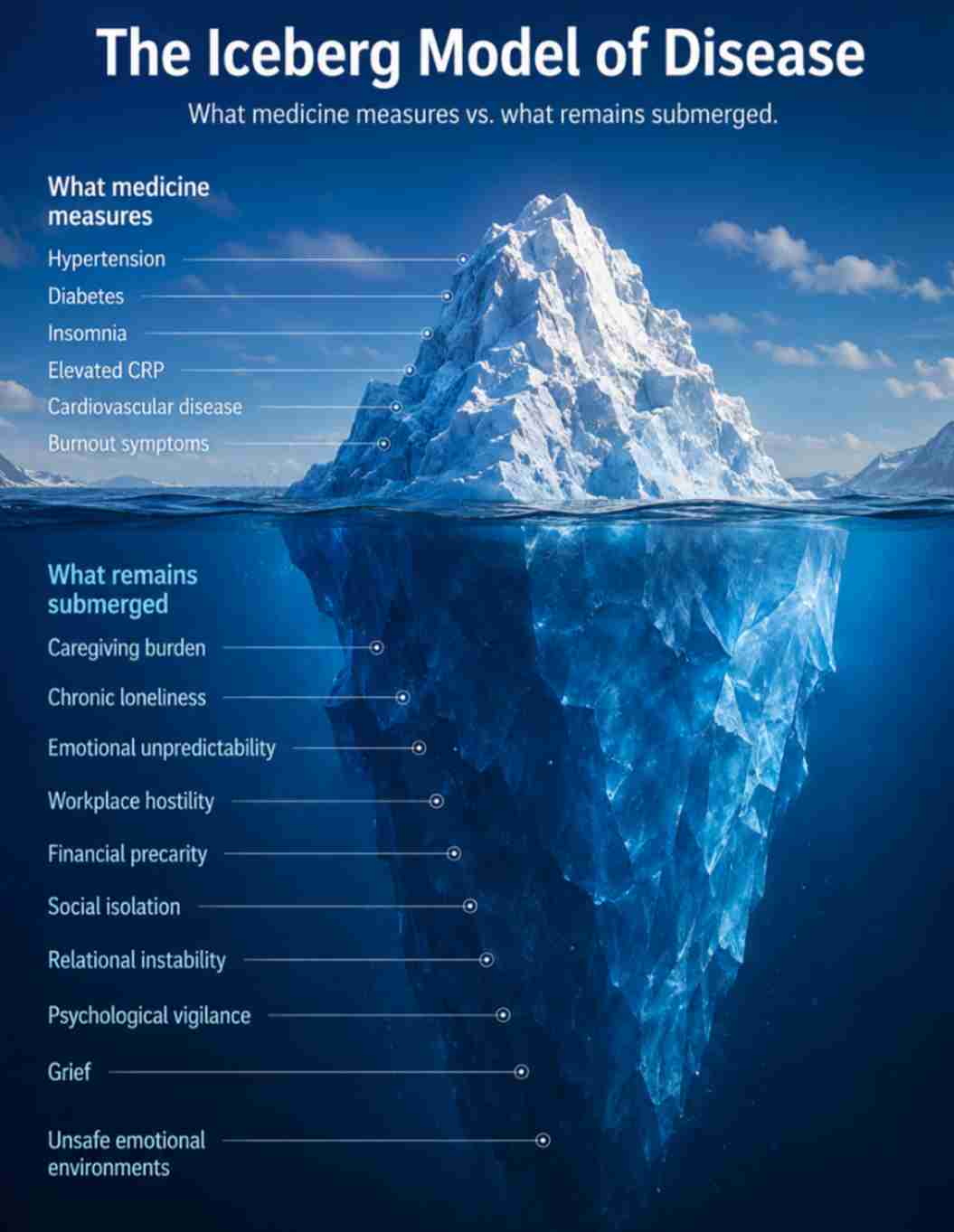 Figure 1: The Iceberg Model of Disease: Visible Pathology and the Hidden Psychosocial Architecture of Illness. Conceptual illustration depicting the relationship between visible clinical manifestations of disease and underlying psychosocial determinants, including loneliness, caregiving burden, workplace hostility, social isolation, emotional strain, and financial insecurity, which may contribute to chronic stress physiology and long-term health outcomes. Source: Original conceptual illustration created by the author using generative artificial intelligence.
Psychosocial Stress and Disease
Medicine has historically treated emotional suffering with a peculiar duality. Clinicians routinely observe its consequences in clinical practice. Blood pressure may rise during prolonged caregiving strain. Glycaemic control may worsen during marital instability. Chronic loneliness may influence sleep, appetite, motivation, adherence, and immune resilience. Burnout may alter cognition long before it alters laboratory values. Yet despite these observations, psychosocial suffering often remains conceptually peripheral within mainstream biomedical frameworks.
The recent article by Lee et al contributes to a growing body of evidence suggesting that persistent interpersonal strain may influence inflammatory pathways, biological aging, and multimorbidity through chronic activation of stress-response systems [1]. The broader significance of this literature lies not simply in the recognition that stress influences health, but in the gradual collapse of the traditional boundary separating social experience from biological consequence.
For decades, disease models have largely prioritized exposures that are visible, measurable, and materially concrete: tobacco smoke, hyperglycemia, lipid accumulation, infectious pathogens, and environmental toxins. Psychosocial adversity is subjective, relational, culturally variable, and resistant to clean causal interpretation. Nevertheless, advances in psychoneuroimmunology increasingly suggest that human physiology may continuously absorb, interpret, and biologically encode social environments in ways previously underestimated [2]
Inflammatory and neuroendocrine systems do not necessarily distinguish sharply between infection, caregiving exhaustion, chronic vigilance, emotional unpredictability, financial precarity, social isolation, or prolonged psychological threat. Human stress physiology evolved largely in environments where threats were acute and time-limited. Contemporary stressors are often chronic, repetitive, socially mediated, and psychologically inescapable [3].
Psychosocial Stress Within Social Contexts
One of the most important conceptual contributions of psychoneuroimmunology has been the recognition that chronic psychosocial adversity may exert cumulative physiological effects by repeatedly activating adaptive stress systems. The hypothalamic–pituitary–adrenal axis, the sympathetic nervous system, inflammatory signalling pathways, and neuroendocrine regulation continuously respond to perceived threat, instability, emotional conflict, social exclusion, and chronic vigilance (Figure 2).
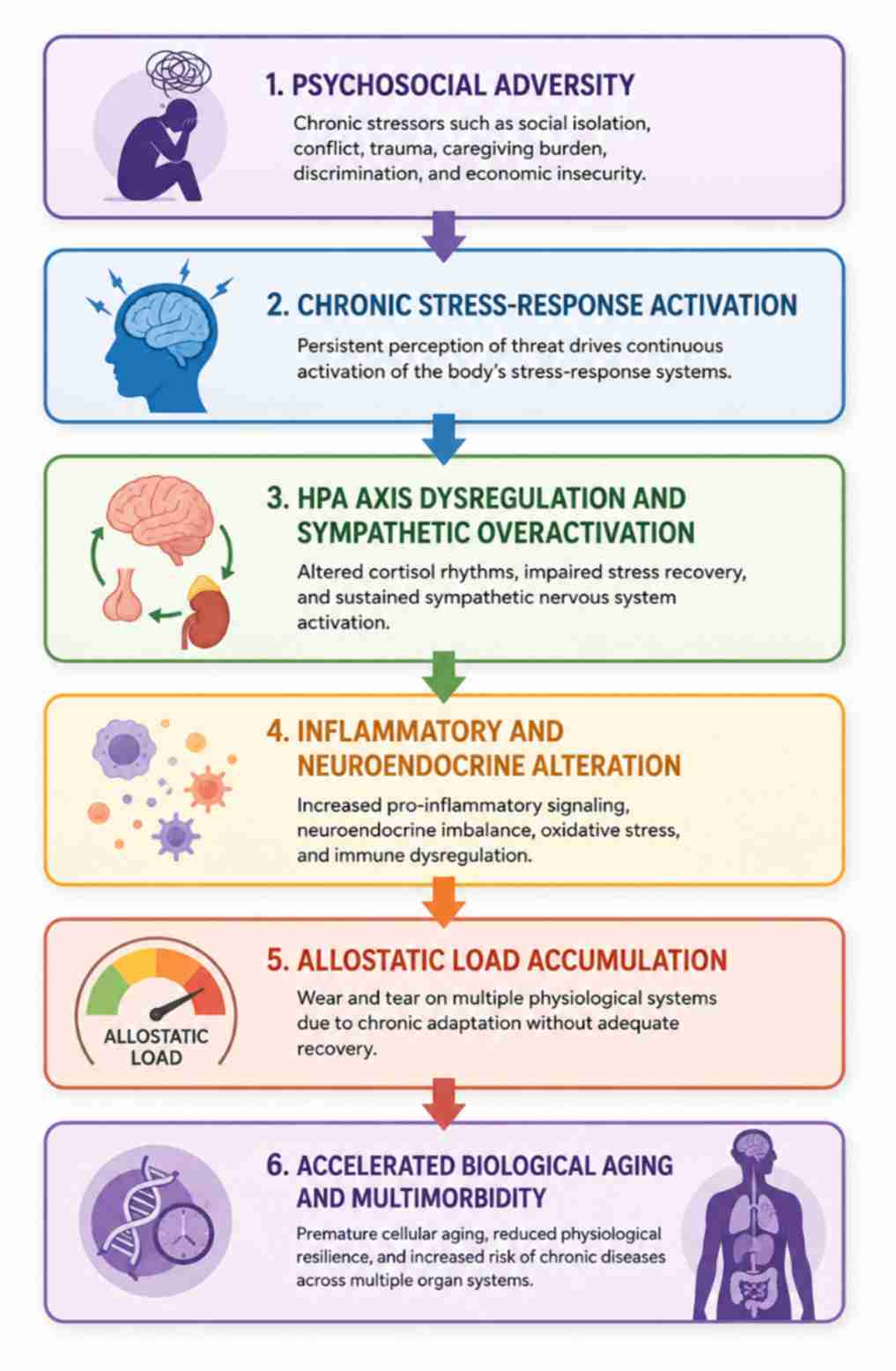 Figure 2. Conceptual Framework: Biological Embedding of Chronic Psychosocial Stress. Conceptual framework illustrating the proposed biological pathways through which chronic psychosocial adversity may influence physiological function, including activation of the hypothalamic–pituitary–adrenal axis, the sympathetic nervous system, inflammatory signalling, neuroendocrine regulation, and allostatic load. Source: Original conceptual illustration created by the author using generative artificial intelligence.
This does not imply that every difficult relationship biologically damages the body in a deterministic fashion. Human resilience remains highly variable, and social experiences are layered, reciprocal, and context dependent. However, the concept of allostatic load introduced by Danese et al. remains highly relevant in understanding how prolonged stress exposure may gradually reshape inflammatory tone, cortisol regulation, autonomic balance, endothelial function, sleep architecture, and metabolic resilience [4].
Physiological adaptation is protective in the short term. Difficulties emerge when adaptive systems remain persistently activated without adequate recovery. Repeated exposure to relational instability, emotional hostility, caregiving exhaustion, social threat, or prolonged psychological uncertainty may contribute to cumulative biological strain over time. Representative psychosocial stressors, their proposed biological pathways, and potential clinical consequences are summarized in Table 1.
Table 1. Psychosocial Stressors as Potential Biologically Embedded Exposures
| PSYCHOSOCIAL EXPOSURE | POTENTIAL PHYSIOLOGICAL PATHWAY | POSSIBLE CLINICAL CONSEQUENCE |
| Chronic interpersonal conflict | HPA axis dysregulation | Hypertension |
| Caregiving exhaustion | Sustained cortisol alteration | Metabolic dysfunction |
| Social isolation | Chronic low-grade inflammation | Immuno-senescence |
| Workplace hostility | Sympathetic overactivation | Cardiovascular strain |
| Emotional unpredictability | Impaired autonomic recovery | Sleep disruption |
| Persistent social threat | Allostatic overload | Multimorbidity |
Women with the highest levels of perceived stress have telomeres shorter on average by the equivalent of at least one decade of additional aging compared to low-stress women. These findings have implications for understanding how stress, at the cellular level, may promote the earlier onset of age-related diseases [5].
Importantly, these processes are unlikely to be entirely linear. Biological embedding may occur gradually through repeated, low-grade activation of stress-response pathways rather than through isolated catastrophic events. Modern medicine remains highly skilled at identifying acute pathology but comparatively less equipped to recognize cumulative physiological erosion associated with chronic psychosocial burden.
The difference between healthy physiological recovery following acute stress and the cumulative biological burden associated with chronic unresolved psychosocial stress is illustrated in Figure 3.
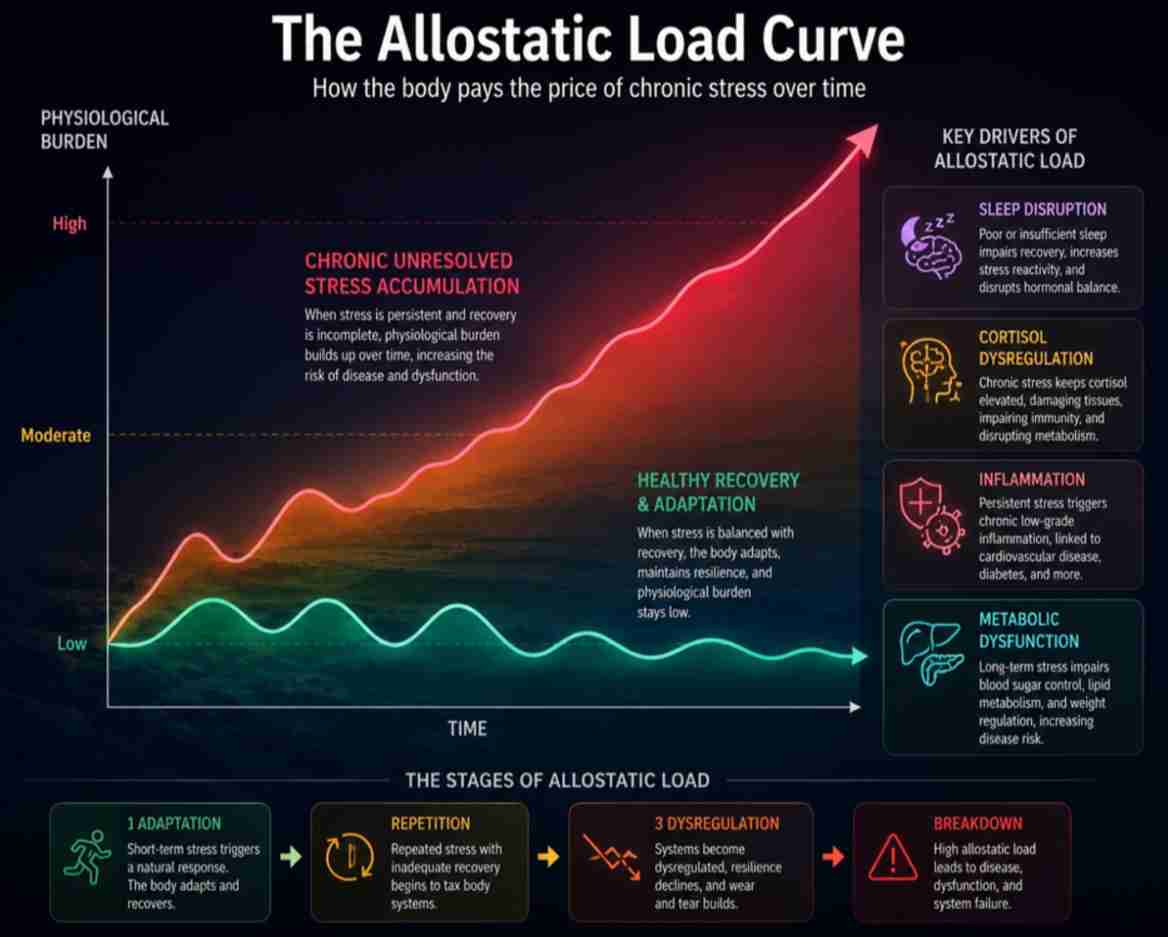 Figure 3. The Allostatic Load Curve. Conceptual illustration showing the progressive accumulation of physiological burden associated with chronic psychosocial stress. Repeated activation of the hypothalamic–pituitary–adrenal axis, sympathetic nervous system, and inflammatory pathways without adequate recovery may contribute to neuroendocrine dysregulation, chronic low-grade inflammation, metabolic dysfunction, and accelerated biological ageing. Source: Original conceptual illustration created by the author using generative artificial intelligence.
The Social Architecture Beneath “Toxic Relationships”
One limitation of contemporary discourse surrounding psychosocial stress is the tendency to individualize fundamentally structural problems. The language of “toxic people” may be emotionally intuitive and socially marketable, but it is also frequently reductionist.
Human relationships do not emerge independently from the environments that shape them. Caregiver burnout cannot be separated from fragmented support systems. Workplace hostility cannot be separated from institutional culture. Chronic emotional strain cannot be fully separated from economic insecurity, unstable employment, urban isolation, migration stress, gender inequity, or precarious living conditions.
Social epidemiology has repeatedly demonstrated that health outcomes are shaped not only by individual behaviour, but also by the conditions in which people live, work, age, and interact [6,8]. Yet medicine often continues to individualize suffering that may be structurally distributed.
A patient presenting with poorly controlled diabetes may simultaneously be navigating caregiving exhaustion, financial precarity, occupational instability, sleep deprivation, and chronic loneliness. Laboratory abnormalities become clinically evident, while the broader social architecture that contributes to them may remain insufficiently recognized.
Beyond these structural influences, the cardiovascular consequences of chronic psychosocial stress are increasingly well documented. Epidemiological evidence indicates that chronic stress predicts coronary heart disease (CHD), while acute emotional stress may precipitate stress-induced cardiomyopathy (Takotsubo syndrome) in susceptible individuals [7].
The modern social environment has further intensified these complexities. Digital hyperconnectivity has increased exposure to comparison culture, social surveillance, performative identity construction, chronic psychological stimulation, and online hostility.
At the same time, loneliness continues to rise across many societies despite increasing technological connectedness. Individuals may now remain socially exposed while simultaneously experiencing profound emotional isolation.
Methodological Humility in an Age of Biological Narratives
The expanding literature on psychosocial stress and biological aging is compelling, but it also remains methodologically complex in important ways. Correlation does not establish causation. Inflammatory biomarkers are probabilistic rather than deterministic, and self-reported relational experiences remain vulnerable to perception bias, recall distortion, and psychological state effects.
Chronic illness itself may strain relationships. Depression may alter social interpretation. Trauma histories may influence both physiological regulation and interpersonal perception. Socioeconomic adversity may simultaneously shape inflammation, emotional strain, health behaviours, and healthcare access.
These limitations do not invalidate the field; rather, they emphasize the importance of interpretive caution. The greater concern lies in premature simplification. Contemporary wellness culture has shown a strong tendency to reduce nuanced biopsychosocial science into emotionally attractive slogans such as “stress kills” or “toxic people age you faster.” Such narratives may attract attention while obscuring the complexity that the science itself is attempting to clarify. Key methodological challenges in psychosocial aging research are summarized in Table 2.
Table 2. Key Challenges in Psychosocial Aging Research
| THE CHALLENGE | IMPLICATIONS |
| Correlation versus causation | Directionality remains uncertain |
| Self-reported social ties | Vulnerable to subjective interpretation |
| Residual confounding | Social and biological variables interact extensively. |
| Biomarker variability | Aging markers remain probabilistic. |
| Cultural variability | Social experiences differ across contexts. |
| Reverse causality | Chronic illness may influence relationships. |
Human relationships cannot be understood solely through laboratory-style exposures; any more than biological aging can be reduced to a moral or emotional narrative. Serious scholarship, therefore, requires conceptual integration without explanatory oversimplification.
Clinical Implications: What Medicine Still Fails to Ask
Modern clinical practice excels at quantification. Blood glucose, troponin, CRP, LDL cholesterol, and eGFR are measured with increasing precision. Yet many consultations still fail to ask questions that may substantially shape physiological recovery:
Who is caring for you?
What is exhausting you?
Do you feel emotionally safe where you live?
Are you chronically alone?
When was the last time you experienced psychological rest?
This omission is not merely interpersonal. It reflects a broader epistemological tendency within medicine to prioritize what can be measured rapidly over what must be understood contextually.
The challenge is not to transform physicians into therapists or to pathologize ordinary emotional difficulty. Rather, it is to recognize that psychosocial realities may exert meaningful physiological influence while remaining largely absent from conventional risk assessment models.
Clinicians already recognize fragments of this intuitively: the patient whose hypertension worsens during caregiving collapse, the resident physician whose insomnia progresses into cognitive fatigue, the older adult whose inflammatory disease advances alongside profound loneliness, or the exhausted caregiver whose body appears clinically functional while physiologically depleted.
The deeper question is whether medicine is prepared to treat psychosocial burden not merely as background narrative, but as a biologically relevant clinical context.
Public Health Beyond Behavior
Public health has historically focused on behavior modification: smoking cessation, physical activity, alcohol reduction, and dietary improvement. These remain essential. Increasingly, however, chronic disease prevention may also require attention to relational ecosystems, social fragmentation, emotional environments, labour structures, loneliness, caregiving systems, and psychological safety.
This represents an important conceptual expansion of what constitutes a public health exposure. Not all harmful exposures are inhaled. Some are endured.
The policy implications are substantial. Community infrastructure, caregiver support systems, workplace protections, accessible mental healthcare, social cohesion initiatives, and interventions targeting loneliness may ultimately influence physiological health more profoundly than traditionally appreciated.
The future of prevention may depend partly on whether health systems can integrate social physiology into mainstream medical thinking without collapsing into reductionism or wellness rhetoric.
Conclusions and Clinical Implications
The growing literature connecting psychosocial stress, inflammation, accelerated aging, and multimorbidity reflects an important shift in how medicine conceptualizes health and disease. Emerging evidence increasingly suggests that emotional environments and social experiences may exert measurable physiological effects across the lifespan.
The broader significance of this research lies not simply in demonstrating that emotional strain influences biology.
Rather, it challenges the longstanding tendency to separate human physiology from the social and emotional conditions within which it continuously operates.
In much of modern medicine, disease has been conceptualized primarily in terms of organs, molecules, pathogens, and measurable pathology.
Yet physiology does not exist independently from biography, caregiving burden, loneliness, instability, grief, work-related exhaustion, social belonging, or chronic psychological strain.
The future challenge for medicine is therefore
not merely technological sophistication, but conceptual maturity: the ability to hold biological precision and social complexity simultaneously without reducing one into the language of the other.
This will require clinicians capable of tolerating ambiguity, researchers committed to methodological restraint, and policymakers willing to recognize loneliness, instability, and chronic psychosocial adversity as legitimate public health concerns rather than purely private emotional experiences.
Increasingly, the question is no longer whether psychosocial suffering may become biologically relevant. The more important question is how health systems intend to respond to that reality.
Nonstandard Abbreviations: CRP, C-reactive protein; HPA, hypothalamic–pituitary–adrenal; eGFR, estimated glomerular filtration rate; LDL, low-density lipoprotein
Author’s Affiliation
Dr. Sneha J. Patil, MBBS, MD Community Medicine, Department of Community Medicine
GMERS Medical College Valsad, Gujarat, India. Email: drsneha01p@gmail.com; Phone: +91 7588683235
References:
- Lee B, Ciciurkaite G, Peng S, Mitchell C, Perry BL. Negative social ties as emerging risk factors for accelerated aging, inflammation, and multimorbidity—Proc Natl Acad Sci U S A. 2026;123(8):e2515331123.
- McEwen BS, Stellar E. Stress and the individual: mechanisms leading to disease. Arch Intern Med. 1993;153(18):2093–2101.
- Cohen S, Janicki-Deverts D, Miller GE. Psychological stress and disease. JAMA. 2007;298(14):1685–1687.
- Danese A, McEwen BS. Adverse childhood experiences, allostasis, allostatic load, and age-related disease. Physiol Behav. 2012;106(1):29–39.
- Epel ES, Blackburn EH, Lin J, Dhabhar FS, Adler NE, Morrow JD, Cawthon RM. Accelerated telomere shortening in response to life stress. Proc Natl Acad Sci U S A. 2004;101(49):17312–17315.
- Holt-Lunstad J, Smith TB, Layton JB. Social relationships and mortality risk: a meta-analytic review. PLoS Med. 2010;7(7):e1000316.
- Steptoe A, Kivimäki M. Stress and cardiovascular disease. Nat Rev Cardiol. 2012;9(6):360–370.
- Cacioppo JT, Cacioppo S. Social relationships and health: the toxic effects of perceived social isolation. Soc Personal Psychol Compass. 2014;8(2):58–7
Author’s Note: All figures are original conceptual illustrations created by the author using generative artificial intelligence and are not reproduced or adapted from previously published material. Accordingly, no external source or DOI applies.
Related stories you may like:
The Stress Continuum of Chronic Disease Development
Childhood adversities and development of asthma in adulthood
Childhood roots of health disparities
Childhood Stress and Elevated Antibody Levels to Herpes Simplex Virus Type 1 in Adolescence
Childhood Disrupted: How Your Biography Becomes Your Biology and How You Can Heal
Prenatal Immune Challenge – ‘Disease Primer’ Increasing the Offspring’s Vulnerability to Stress
Lifetime Adversity Is Associated with Inflammation and Elevated CRP Levels
The Link Between Stress, Emotions and Cytokine-Related Diseases
The Pervasive Influence of Stress on the Pathogenesis of Human Diseases as Covered on BrainImmune
Hans Selye and the Birth of the Stress Concept
The Paradox of Stress: Understanding Hans Selye’s Enduring Observation