

Thyroxine – Inhibitor of Migration Inhibitory Factor
 A study published in the Proceedings of the National Academy of Sciences of the United States of America (PNAS) suggests that thyroxine (T4) is a strong endogenous inhibitor of the migration inhibitory factor (MIF) pro-inflammatory activities. Importantly, the study also indicates that low T4 and high MIF levels may contribute to the lethal systemic inflammatory response during severe sepsis.
Low circulating thyroid hormone levels are common in critically ill patients with severe infections and about 60% of these patients have abnormally low plasma T4 levels, with the lowest levels being observed in patients with sepsis.
The mechanism behind this phenomenon, often referred to as “euthyroid sick syndrome” remain poorly understood. Euthyroid sick syndrome (ESS) is a state of adaptation or dysregulation of thyrotropic feedback control wherein the levels of T3 and/or T4 are abnormal, but the thyroid gland does not appear to be dysfunctional. The classical phenotype of this condition is often seen in starvation, critical illness, or patients in the intensive care unit. Similar endocrine phenotypes are observed in fetal life and in hibernating mammals.
This condition occurs in the setting of a nonthyroidal illness (NTI), without preexisting hypothalamic-pituitary and thyroid gland dysfunction. The most prominent alterations are low serum triiodothyronine (T3) and elevated reverse T3 (rT3), leading to the general term “low T3 syndrome. But approximately 60% of critically ill patients have abnormally low plasma T4 levels, with the lowest levels being observed in patients with sepsis. These low thyroid hormone levels are good indicators of disease severity and predictors of mortality.
Macrophage migration inhibitory factor (MIF), also known as glycosylation-inhibiting factor (GIF), L-dopachrome isomerase, or phenylpyruvate tautomerase is a protein that in humans exerts important regulatory effects on innate immunity. Bacterial antigens stimulate white blood cells to release MIF into the blood stream. The circulating MIF binds to CD74 on other immune cells to trigger an acute immune response.
Migration inhibitory factor is a cytokine involved in cell-mediated immunity, immunoregulation, inflammation, and is also known to be induced by glucocorticoids, and being able to override their anti-inflammatory actions.
Glucocorticoids are known to stimulate white blood cells to release MIF and hence MIF partially counteracts the inhibitory effects that glucocorticoids have on the immune system. Importantly, trauma activates the anterior pituitary gland to release MIF.
Migration inhibitory factor is implicated in the pathogenesis of systemic infections, autoimmune diseases, cancer, metabolic disorders and atherosclerosis. Of note, plasma MIF levels are significantly elevated in non-survivors of severe sepsis, compared with survivors, and administration of antibodies against MIF improves survival in experimental sepsis.
The authors of the PNAS study review the literature and previous work indicating that during sepsis, plasma MIF levels can be higher than 180 ng/mL, and the increased accumulation of MIF can have a profound effect on organ function and mortality.
In the PNAS study, Yousef Al-Abed and colleagues from the Feinstein Institute for Medical Research, Manhasset, NY, USA, provide evidence for an inverse correlation between plasma T4 and MIF levels during the progression of sepsis, and identify T4 as a potential endogenous antagonist of MIF inflammatory activity.
Consistent with these human data, plasma free-T4 levels decreased and plasma MIF levels increased within hours after the onset of severe sepsis in rats induced by cecal ligation and punctur. Moreover, administration of exogenous D-T4 significantly improved survival in mice with severe sepsis.
The data suggest that low T4 and high MIF may be primary effectors in the lethal systemic inflammatory response during severe sepsis as modulation of either (T4 replacement or MIF antagonism) can improve survival.
According to the authors the low plasma free T4 levels “could result from a significant endogenous T4 fraction binding the hydrophobic pocket within the MIF molecule”. As during sepsis, plasma MIF levels can reach high levels, “this binding may not be sufficient to effectively inhibit MIF pro-inflammatory activity and prevent an overwhelming inflammatory response”.
These findings indicate a previously unrecognized but clinically relevant interaction between T4 and MIF, two key molecules in the critically ill patient with severe infections.
SOURCE: Proc Natl Acad Sci USA 2011, 108:8224. Epub 2011 May 2
Updates
A 2019 study by Ayman Abd Elrahman et al. indicated that serum macrophage migration inhibitory factor (MIF) levels increased in overt and subclinical hypothyroidism due to Hashimoto’s thyroiditis (HT) and their levels were positively correlated with thyroid-specific autoantibodies and TSH.
Background: Hashimoto’s thyroiditis (HT) is considered as the main cause of hypothyroidism especially in iodine-sufficient areas. Macrophage migration inhibitory factor (MIF) is one of the recently recognized cytokines that has a broad range of inflammatory and immune effects. Serum levels of MIF have been shown to be present in excess in several other autoimmune disorders like Wegener’s granulomatosis, rheumatoid arthritis, and systemic lupus erythematosus.
According to the authors MIF may play a role in the pathogenesis and development of thyroid autoimmune responses in patients with HT, not only in the initial phase, but also in the later phase of the disease. They recommend further larger studies to assess the MIF role in the development and prognosis of HT.
A 2019 review by María del Mar Montesinos and Claudia Gabriela Pellizas outlines the cellular and molecular mechanisms involved in T4 and T3 effects on innate immune cells. An overview of the state-of-the-art of TH transport across the target cell membrane, TH metabolism inside these cells, and the genomic and non-genomic mechanisms involved in the action of THs in the different innate immune cell subsets is included.
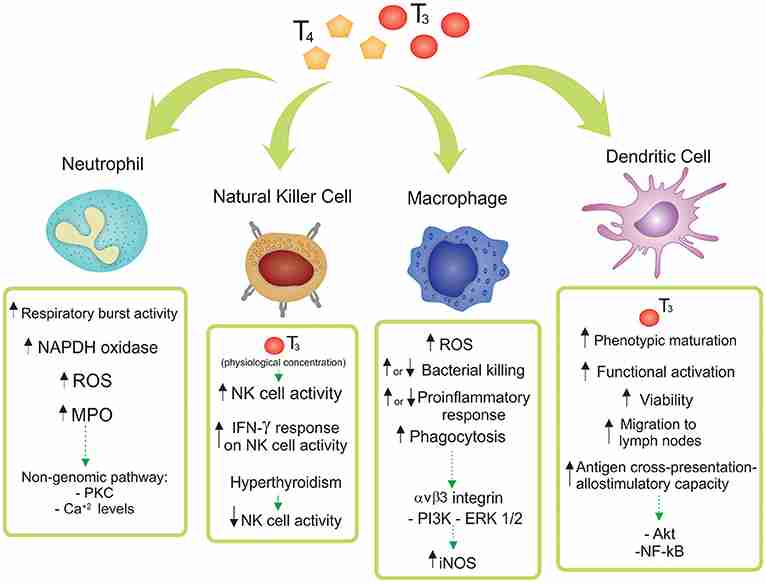 Figure: Effects of thyroid hormones 3,3′,5,5′ tetraiodo-L-thyroxine (T4) and 3,3′,5-triiodo-L-thyronine (T3) on innate immune cell subsets. The main reported effects of T3 and/or T4 in Neutrophils, Natural Killer (NK) cells, Macrophages and Dendritic Cells are depicted. Particular differences among the diverse origins of the cells (human, mice, cell lines, and/or tissue source) are shown and discussed in the main text.
The authors of this review emphasize that the etiopathogenic mechanism involved in both immune-related thyroid pathologies and immune disorders due to thyroid dysfunctions are now better understood. Thus, cellular and molecular signaling pathways involved in the crosstalk between THs and innate immune functions, and their role directing adaptive immunity have profound implications in immunopathology, including cancer and autoimmune manifestations of the thyroid gland, at the crossroads of the immune and endocrine systems.
According to the authors further research will provide valuable tools for manipulating the immunogenic potential of innate immune cells to positively regulate the development of protective immunity, or negatively control the generation of autoimmune thyroid inflammation.
Cover Image Credit (Right panel): Role of macrophage migration inhibitory factor (MIF) in inflammation and adipose tissue dysfunction. 1. MIF activates macrophages inducing inflammatory cytokine secretion; TNF-α and IL-12. 2. Inflammatory stimuli lipopolysaccaride (LPS), TNF-a and interferon-g can induce MIF secretion from macrophages. 3. Endogenous MIF can regulate toll-like receptor-4 (TLR-4), IL-1 receptor (IL-1R)1, TNF receptor (TNFR) expression 4. MIF inhibits macrophage-derived anti-inflammatory IL-10 secretion. 5. MIF is involved in monocyte recruitment via transmigration and recruitment of monocytes by up-regulating intracellular adhesion molecule-1 (ICAM) and monocyte chemoattractant protein-1 (MCP)-1 and can also by binding to CXC-chemokine receptor (CXCR)2. 6. MIF can promote TNF-a secretion from adipocytes 0 . 7. MIF can impair insulin-stimulated glucose uptake into adipose tissue and down-regulate phosphorylated AKT expression. From: Insights into the role of macrophage migration inhibitory factor in obesity and insulin resistance, by Orla M Finucane, Clare M Reynolds, Fiona C McGillicuddy, Helen M Roche; Proceedings of The Nutrition Society 71(4):622-33.
Related stories you may like:
Stress-Induced Th2 Shift & Thyroid Autoimmunity: Unifying Hypothesis
Caleb Parry and the Relationship Between Hyperthyroidism and Stress
New evidence that Th17 Cells Contribute to Hashimoto’s Thyroiditis