
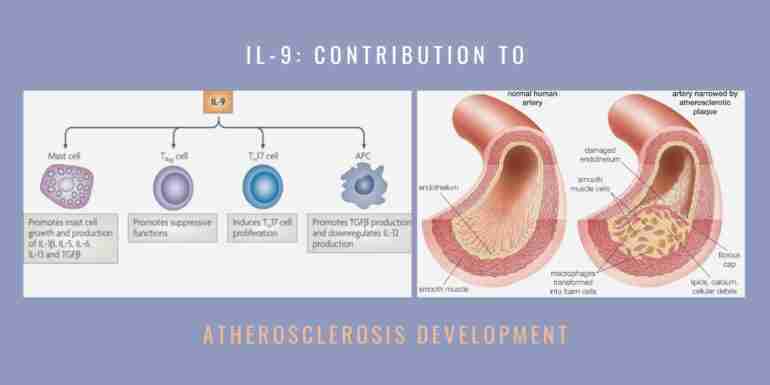
IL-9 – Atherosclerosis
Perhaps the first evidence for an involvement of interleukin (IL)-9 in atherosclerosis was recently reported in the online journal PLoS One by Ida Gregersen and colleagues from the Oslo University Hospital Rikshospitalet, Oslo, Norway.
Several studies demonstrate altered levels of various cytokines in atherosclerotic disorders, both systemically and within the atherosclerotic plaque. However, although the concept of inflammation as a major mediator in atherosclerosis is well established, the identification of the different actors in this complex network is not fulfilled.
Interleukin (IL)-9 is a cytokine linked mostly to T helper (Th)2 cell responses and Th2-related conditions such as parasitic helminth infections and allergy/asthma. The major source of interleukin-9 is T lymphocytes, and particularly the newly defined Th9 cells.
Interleukin-9 was first recognized as a T helper cell type 2 (Th2)-related cytokine, but it is now clear that IL-9 is produced by various CD4+ T-cell subsets, including the newly defined Th9 cells. Interleukin-9 expression is also observed in granulocytes, dendritic cells and mast cells. The IL-9 receptor (IL-9R) consists of a specific α-chain and a signal unit (γ-chain) that is shared with other members of the IL-2-related cytokine family such as IL-2, IL-4, IL-7 and IL-15.
While interleukin-9 has been implicated as a pathogenic mediator of asthma and allergic disorders, recent studies suggest that interleukin-9 may enhance as well as dampen the progression of various autoimmune disorders.
Increased plasma levels of IL-9 are seen in patients with heart failure, possibly correlated to disease progression, and increased IL-9 levels have been reported in experimental cardiomyopathy. Interleukin-9 has also been shown to facilitate Th17 cell expansion, and to stimulate production of IL-17 from mononuclear cells of both healthy and diseased subjects such as patients with psoriasis.
There are also some reports of increased interleukin-9 levels in relation to systemic sclerosis and experimental transplant allograft rejection. To this end, however, there are to the best of our knowledge, no data on the regulation of IL-9 in atherosclerotic disorders.
In the PLoS One study the authors report for the first time increased levels of both interleukin-9 and interleukin-9R in patients with carotid and coronary atherosclerosis. Through investigation of three different populations of atherosclerotic patients the authors found elevated circulating levels of interleukin-9, and increased interleukin-9 and IL-9R expression in cells and tissue of patients with carotid and coronary atherosclerosis.
Moreover, patients with STEMI had markedly elevated interleukin-9 levels on admission, a few hours after symptom debut, with a gradual decline during the following week. In contrast to several other inflammatory markers there was no interleukin-9 increase following PCI, suggesting only minor regulation by ischemia and reperfusion injury. Finally, enhanced expression was also seen at the cellular level with increased levels of interleukin-9 mRNA and IL-9R in T cells from patients with unstable angina, and for interleukin-9, this up-regulation was also seen in monocytes.
In addition to increased systemic expression, the present study also showed enhanced expression of interleukin-9 and its receptor within the atherosclerotic lesion. Thus, when compared with non-atherosclerotic vessels (common iliac artery), carotid plaques had markedly elevated mRNA levels of interleukin-9 and IL-9R. Moreover interleukin-9 co-localized to both T cells and macrophages and IL-9R to T-cells, as assessed by IHC. The fact that interleukin-9 and IL-9R showed the same pattern in asymptomatic and symptomatic lesions could suggest that these mediators are related to the chronic atherosclerotic process, rather than to plaque destabilization.
Interleukin-9 is also known to support Th17 cell expansion. As in this study the cytokine potentiated the release of IL-17 in peripheral blood mononuclear cells, and particularly in cells from unstable angina patients, the authors suggest that the effects of interleukin-9 in atherosclerosis are most likely IL-17-mediated. Of note, recent reseach indicate that the key pro-inflammatory and highly pathogenic cytokine IL-17 contributes to atherosclerosis.
The study suggests that the IL-9–IL-9R interaction, and the link between interleukin-9 and IL-17 are probably involved in atherosclerosis development, but this needs further, more detailed investigation.
Source: PLoS One. 2013 Aug 30;8(8):e72769. doi: 10.1371/journal.pone.0072769.
Read More: PLoS One
Updates
A 2015 study indicates that IL-9 exerts pro-atherosclerotic effects in ApoE−/− mice at least partially by inducing VCAM-1 expression, which mediates inflammatory cell infiltration into atherosclerotic lesions.
In a 2017 study the amounts of Th9 cells as well as their key transcription factors and relevant cytokines during atherosclerosis were assessed in ApoE-/- mice and age-matched C57BL/6J mice.
Background: It has also been reported that Th9 cells and IL-9 are related to the pathogenesis of infectious diseases, cancer immunity, and autoimmune inflammatory disorders. Of note, Th9 cells activate macrophages through IL-9 secretion, leading to the formation and development of atherosclerotic lesions.
In the 2017 study significantly increased Th9 rates were found in ApoE-/- mice fed a high-fat diet, as well as higher amounts of the related cytokine IL-9 and key transcription factor (PU.1), compared with age-matched C57BL/6J wild type counterparts. These findings suggested that increased Th9 cell count could play a pathogenic role in the formation and progression of atherosclerosis.
The authors concluded that the Th9 cell amounts, along with IL-9 and PU.1 levels were significantly elevated in atherosclerosis. Administration of rIL-9 markedly increased plaque size, which was dramatically reduced by treatment with IL-9 mAb, indicating that Th9 cells and IL-9 play a pathogenic role in atherosclerosis. Consequently, antibodies targeting Th9 cells and/or IL-9 may provide a novel approach for atherosclerosis treatment.
Related stories you may like:
Chlamydophila pneumonia phospholipase D is a potent inducer of Th17 inflammation in atherosclerosis
Coronary Artery Disease and the link to Stress and Immunity
Interleukin-6 – a Better Predictor of Future Cardiovascular Events Than C-Reactive Protein?