
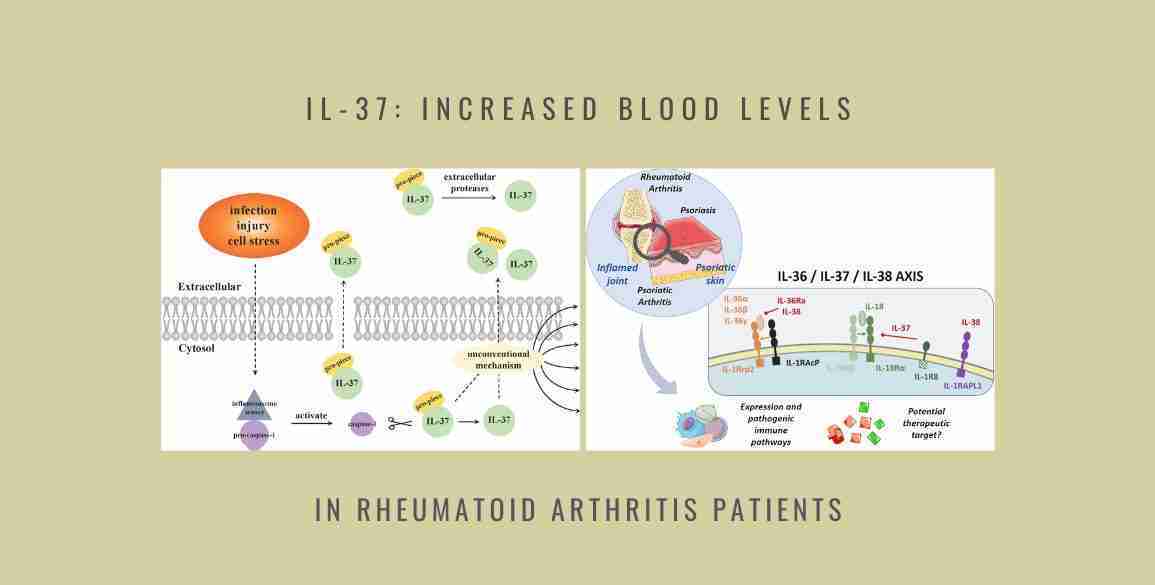
IL-37 – rheumatoid arthritis
A recent study published in PLoS One suggests that interleukin (IL)-37 is involved in a control circuit that tries to regulate inflammation in rheumatoid arthritis.
Rheumatoid arthritis (RA) is associated with increased levels of pro-inflammatory cytokines such as IL-6, IL-17A and tumor necrosis factor (TNF)-α.
Early intervention and treatment of RA is based on disease-modifying anti-rheumatic drugs (DMARDs), which are aimed to reduce synovial inflammation and damage, as well as, local or systemic cytokine production.
IL-37 is a new member of the anti-inflammatory cytokine family, described in 2000, and like IL-1 and IL-18, is produced as a precursor that must be cleaved by caspase-1 to be activated.
IL-37 is considered a natural suppressor of pro-inflammatory cytokines production and excessive inflammation, acting presumably as a negative feedback inhibitor of inflammatory responses, a function that is not dependent on anti-inflammatory cytokines such as IL-10 (Marcel F Nold et al., 2010; Jacques Banchereau et al., 2012).
Previous research indicates that IL-37 is increased in plasma of patients with severe systemic lupus erythematosus (SLE), lamina propria macrophages of patients with Crohn’s disease, and the synovial tissue of RA patients. However, systemic IL-37 levels and the correlation between IL-37 and disease activity in RA patients have not yet been investigated.
In the study published in PLoS One, Ping-Wei Zhao and colleagues, from the Jilin University, Changchun, China, evaluated pro- and anti-inflammatory cytokine profiles in 50 newly diagnosed RA patients, before and after DMARD therapy with methotrexate and leflunomide.
In this study, the authors found that plasma levels of IL-37 were elevated in RA patients, and the IL-37 concentrations positively correlated with the levels of TNF-α and IL-17A, and also with the disease activity, as evidenced by CRP levels. Patients that qualified as good DMARDs-treatment responders had down-regulated IL-17A, IL-6 and TNF-α expression but also IL-37 levels.
This relatively small study indicates that IL-37 production is most likely induced by pro-inflammatory cytokines during an active disease such as RA.
The authors suggest that this new anti-inflammatory cytokine may be part of a feed-back loop that is aimed to restrict inflammation, a mechanism that may be dysfunctional in rheumatoid arthritis.
Source: PLoS One, 2014, 9(5):e95346. doi: 10.1371/journal.pone.0095346. eCollection 2014
Read more: PLoS One
Updates
2020
A 2020 meta-analysis by Young Ho Lee and Gwan Gyu Song of 14 studies demonstrated that circulating interleukin-37 levels are higher in rheumatoid arthritis (RA) and systemic lupus erythematosus (SLE) patients, and there is a positive correlation between and interleukin-37 activity in RA and SLE. The meta-analysis evidence suggested that circulating interleukin-37 could influence the pathogenesis of RA and SLE.
2021
A 2021 study by Jifeng Zhu et al. explored the potential of interleukin-37 as a diagnostic marker in RA. The authors found that the serum level of interleukin-37 and the mRNA levels of interleukin-37 in both PBMCs and synovial cells correlated with RA severity as reflected by the disease activity score in 28 joints (DAS-28).
Results from the receiver operating characteristic (ROC) analysis supported that the interleukin-37 levels in all three tested compartments are potential diagnostic factors for RA. Overall, this study suggested that serum interleukin-37 level and mRNA expression levels of interleukin-37 in PBMCs and synovial cells correlate with the severity of RA in a Chinese population.
2025
A 2025 review summarizes recent evidence that systemic and local levels of IL-37 and IL-38, anti-inflammatory cytokines, are elevated in RA patients. As discussed by the authors, intriguingly, these levels decrease in individuals experiencing remission, correlating with the Disease Activity Score (DAS28) and histopathological findings. Furthermore, in animal models, exogenous interleukin-37 and IL-38 demonstrate protective effects against RA development, while depletion of either cytokine exacerbates the disease in vivo.
According to the authors, interleukin-37 acts early by inhibiting NF-κB and MAPK signaling, while IL-38 limits Th17 responses and promotes regulatory T-cell function. However, their protective effects may be insufficient in chronic or severe RA.
Related stories you may like:
Sympathetic Nervous System Dysfunction in Rheumatoid Arthritis: Brief Overview
Gut and Gingival Bacteria: Game Changers or Innocent Bystanders in Rheumatoid Arthritis?
Vasoactive Intestinal Peptide Inhibits Pathogenic Th17 Cells from Rheumatoid Arthritis Patients
Pregnancy and Rheumatoid Arthritis
Cover Image Credits: (Left panel): Secretion pattern of IL-37. Inflammasome sensor molecules (such as NLRP3) recognize specific danger signals, including infection, injury or cell stress, and then trigger inflammasome signal complexes assembly. Caspase-1 precursors accumulated upon the complex and are activated, which cleaves IL-37 from precursors to maturations. From: Novel insights into IL-37: an anti-inflammatory cytokine with emerging roles in anti-cancer process, Front. Immunol., 20 October 2023, https://doi.org/10.3389/fimmu.2023.1278521; (Right panel): Graphical Abstract; From: IL-36, IL-37, and IL-38 Cytokines in Skin and Joint Inflammation: A Comprehensive Review of Their Therapeutic Potential, Int. J. Mol. Sci. 2019, 20(6), 1257; https://doi.org/10.3390/ijms20061257