
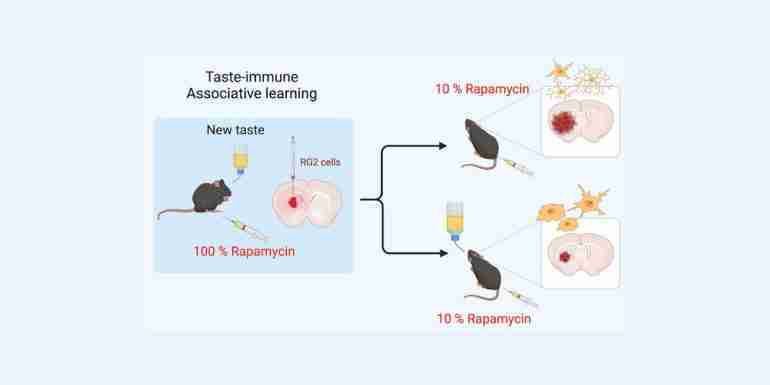
A recent study published in Brain, Behavior, and Immunity demonstrated the potential efficacy of a taste-immune associative learning protocol with rapamycin in rats with syngeneic brain tumors, specifically glioblastoma (GBM).
Continuous drug treatment is an inevitable prerequisite for curbing GBM growth. However, common adverse side effects underscore the necessity for developing alternative or supportive treatment strategies. Building on the bidirectional communication between the central nervous system and the peripheral immune system, previous data have shown that taste-immune associative learning with rapamycin can induce learned pharmacological placebo responses in the immune system. Extending these experimental findings, the current study investigated whether combining learned immunosuppression with the administration of a low-dose pharmacological agent (rapamycin) could effectively inhibit the growth of a brain tumor (GBM).
In collaboration with Susan Hetze, Lennart Barthels, and Ulrich Sure from the Department of Neurosurgery, the team from the Institute of Medical Psychology and Behavioral Immunobiology (Martin Hadamitzky and Manfred Schedlowski) at University Hospital Essen, Germany, demonstrated a learned immunopharmacological prevention in tumor growth. Following repeated pairings of a novel gustatory stimulus with injections of rapamycin, learned immunopharmacological effects were observed in GBM-bearing animals when re-exposed to the gustatory stimulus, even with just 10% of the initial drug dose. This led to a diminished tumor growth nearly identical to that seen with full-dose rapamycin treatment.
These inhibitory effects on tumor growth were accompanied by a decrease in the anti-inflammatory marker IL-10 and an increase in the pro-inflammatory marker CXCL1. The data suggest that taste-immune associative learning with rapamycin fosters a pro-inflammatory anti-tumor microenvironment that significantly mitigates GBM tumor growth.
Behaviorally conditioned immunopharmacological effects, achieved through associative learning, have been successfully implemented in numerous studies as controlled drug-dose reduction strategies to maintain and enhance the efficacy of medical treatments. These approaches have proven effective in experimental animals, healthy subjects, and patient populations. Against this backdrop, Martin Hadamitzky and Manfred Schedlowski propose in an article in Trends in Pharmacological Science that systematic use of conditioned pharmacological effects should be seriously considered as a supportive treatment option to optimize pharmacological treatment effects for the patient’s benefit.
Source: Brain, Behavior, and Immunity, 2022 Nov:106:270-279.
Read More: Brain, Behavior, and Immunity
Cover Image Credit: Graphical abstract, from: Taste-immune associative learning amplifies immunopharmacological effects and attenuates disease progression in a rat glioblastoma model by Susann Hetze, Lennart Barthel, Laura Lückemann, Hauke S. Günther, Clemens Wülfing, Yasmin Salem, Marie Jakobs, Tina Hörbelt-Grünheidt, Jasmin Petschulat, Ivo Bendix, Ulrike Weber-Stadlbauer, Ulrich Sure, Manfred Schedlowski, Martin Hadamitzky; Brain Behav Immun 2022 Nov:106:270-279. Open Access.
Related stories you may like:
Teach the T Cells: Learned Immunosuppressive Placebo Responses in Renal Transplant Patients