
Neurobiology – Cancer
 In a Personal View article, published in The Lancet Oncology Katarina Ondicova and Boris Mravec address a timely topic of growing interest, the role of the nervous system or the neurobiology of cancer etiopathogenesis.
Circa 200 A.D. Galen, the Greek physician and philosopher was perhaps the first to link ‘cancer’ with the person’s emotional and physiologic processes – he noted that “melancholic women were more prone to develop ‘swellings’ of the breasts than were sanguine women“.
In 1701, the British physician Gendron emphasized the effect of “disasters of life as occasion much trouble and grief” in the causation of cancer, and eighty years later, Burrows attributed the disease to “the uneasy passions of the mind with which the patient is strongly affected for a long time.” Approximately 100 years ago, Snow’s review of over 250 patients at the London Cancer Hospital concluded that “the loss of a near relative was an important factor in the development of cancer of the breast and uterus.”
More recent research indicates that the involvement of the nervous system in cancer etiopathogenesis is supported by several observations: tumor tissue is innervated, neurotransmitters affect tumor growth and development of metastases, and altered activity of the nervous system influences tumor cell proliferation.
In the The Lancet Oncology article the authors argue that the neurobiological view of the etiopathogenesis of cancer suggests that the humoral and neural pathways convey information from tumor tissues to the brain, and that the brain then modulates primary tumor and metastatic growth through neuroendocrine-immune systems.
As per Ondicova and Mravec, based on the neurobiological view, cancer can be seen as a process that overcomes not only the protective mechanisms of the immune system, but also the protective influences of the nervous system.
The authors discuss the application of a neurobiological view of cancer etiopathogenesis for development of new cancer treatments, better understanding of the beneficial effects of currently used approaches, and development of new diagnostic tools to detect cancer.
Source: Lancet Oncol, 2010 Jun; 11(6):596-601. doi: 10.1016/S1470-2045(09)70337-7.
Read more: The Lancet Oncology
An Update
A 2022 review by Boris Mravec further develops the major principles and recent findings related to the neurobiology of cancer, i.e., the effect of the nervous system on tumor initiation, progression, and the formation of metastases.
According to the author the role of the nervous system in cancer has been in the spotlight for centuries. Humoral theories of diseases and the experiences of clinicians strongly indicated that cancer is at least partially of psychosomatic nature. Since the 1920’s, advances in the surgical treatment of tumors, and later the introduction of radiotherapy and chemotherapy in oncology, led to a gradual decline of interest in elucidating the role of the nervous system in cancer.
During this period, the previous psychosomatic view of tumors was replaced by the view of tumors as diseases limited to tumor tissue that can be surgically removed or treated with radiotherapy and chemotherapy.
Recently, however, combined neuroscientific and oncological research have created the basis for the neurobiology of cancer, which has brought a new, more complex view of the biology of cancer and elucidated the role that the nervous system plays in this disease.
According to the author the concept of the neurobiology of cancer is based on several pillars: (a) psychosocial factors influence the incidence and progression of cancer diseases; (b) the nervous system affects DNA mutations and oncogene-related signaling; (c) the nervous system modulates tumor-related immune responses; (d) tumor tissues are innervated; (e) neurotransmitters released from nerves innervating tumor tissues affect tumor growth and metastasis; (f) alterations or modulation of nervous system activity affects the incidence and progression of cancers; (g) tumor tissue affects the nervous system (Figure below).
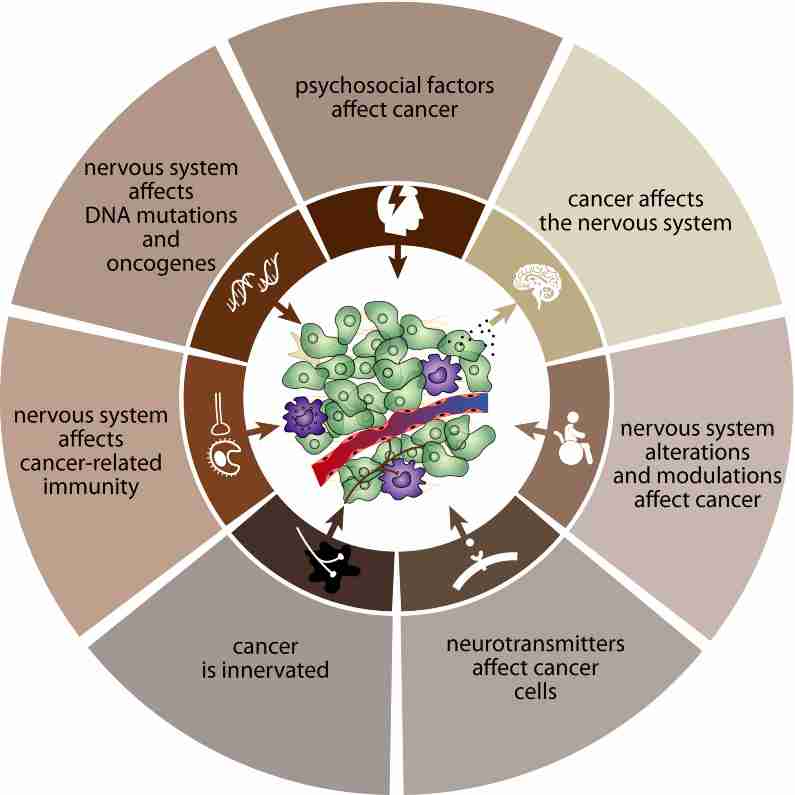 Schematic depiction of the pillars creating a basis for the neurobiology of cancer. These pillars are based on accumulated facts demonstrating that there are bidirectional interactions between the nervous system and cancer. It has been shown that psychosocial factors affect cancer incidence and progression. These effects are mediated, at least partially, by neurotransmitters released by nerves innervating cancer tissue.
Neurotransmitters released by autonomic nerves affects DNA mutations and oncogene-related pathways, stimulates cancer cell proliferation, and modulates cancer-related immunity. The role of the nervous system in cancer is further documented by findings that alterations or modulation of nervous system activity significantly affects cancer incidence and progression. Conversely, cancer also affects brain functions, which might participate in the development of cancer cachexia, for example.
The review by Boris Mravec summarizes the major principles and mechanisms related to the concept of the neurobiology of cancer, which includes: (a) psychosocial factors influence the incidence and progression of cancer diseases; (b) the nervous system affects DNA mutations and oncogene-related signaling; (c) the nervous system modulates tumor-related immune responses; (d) tumor tissues are innervated; (e) neurotransmitters released from nerves innervating tumor tissues affect tumor growth and metastasis; (f) alterations or modulation of nervous system activity affects the incidence and progression of cancers; (g) tumor tissue affects the nervous system.
According to the author the ‘neurobiology of cancer’
- is uncovering new pathways and mechanisms participating in tumorigenesis, proliferation of cancer cells, and the development of metastasis;
- based on these findings, another two hallmarks of cancer have emerged, specifically cancer tissue innervation and cancer-induced changes in the nervous system;
- the neurobiology of cancer also created a basis for repurposing of approved drugs as well as the introduction of new drugs and methods that might be utilized for more efficient cancer treatment and prevention.
Related stories you may like:
Beta-blockers in early and triple-negative breast cancer: the role of a sympathetic overdrive in TNBC
The Sympathetic Nervous System as a Regulator of Breast Cancer Metastasis
Beta-Adrenoceptors and Tumor Development: Novel Concepts and Clinical Implications
More Evidence that Norepinephrine May Drive Melanoma Progression & Aggressiveness
Stress-Induced β2-AR-Mediated M2 Macrophage Polarization & Breast Cancer
First Evidence That Stress and Epinephrine Promote Leukemia Progression